The Real-World Friction of the AI Explosion: Privacy Gaps, Hardware Squeezes, and Cyber Defense

As artificial intelligence expands from experimental novelty into critical infrastructure, today’s headlines offer a sobering snapshot of the friction accompanying its rapid growth. From unexpected privacy vulnerabilities exposing personal conversation logs to physical supply chains buckling under server demands, the hidden costs of the AI boom are becoming impossible to ignore. At the same time, major tech players are doubling down on hyper-specialized models to protect digital networks against emerging threats.
Privacy Cracks, Legal Clashes, and Health Frontiers: Today in AI

Today’s AI news cuts straight through privacy blunders, legal battlegrounds, enterprise defense, and personal healthcare. From web crawlers accidentally surfacing confidential user chats to generative tools triggering fresh intellectual property lawsuits, today highlighted the growing friction between rapid AI rollout and basic digital safety.
In a unsettling reminder of how fragile digital privacy remains, a recent indexing failure exposed conversations meant to stay private. According to a report by WIRED, private Claude chats were exposed in Google and Bing search results. Search engine crawlers managed to index shared links to interactions held with Anthropic’s chatbot, making sensitive queries searchable on the open web. It underscores a persistent technical challenge in modern platform design: as we entrust conversational assistants with sensitive personal and professional details, keeping automated web scrapers from stumbling into those spaces remains an error-prone boundary.
Mandatory AI vs. Human Resistance: The Tension Brewing in Today's Tech World

Today’s artificial intelligence ecosystem presents a stark study in contrasts. On one side, Silicon Valley is relentlessly pushing AI into every corner of human life—from personal health advice to smart glasses and ambient home assistants. On the other side, everyday users are actively seeking escape hatches, searching for ways to turn off the very features tech companies are desperate to sell them.
The most jarring headline of the day comes from OpenAI, which rolled out its dedicated ChatGPT Health feature just twenty-four hours after a high-profile lawsuit was filed against the company in San Francisco. As reported by SFGate, a local man alleges that medical advice generated by ChatGPT nearly cost him his life after the chatbot downplayed severe dizzy spells and advised against seeing a doctor. Launching a specialized health tool right on the heels of such serious allegations highlights a brazen confidence—or perhaps a reckless urgency—to capture the digital health market before regulatory and legal frameworks can catch up. Medical guidance requires strict nuance and safety guardrails, making this one of the highest-stakes arenas for large language models to date.
From Bedtime Stories to ER Visits: AI Is Moving In, Ready or Not

Today’s AI developments aren’t about distant corporate server farms or abstract benchmarks—they are about how artificial intelligence is stepping directly into our private, personal spaces. From organizing family dinners to offering health advice, AI systems are aggressively pushing deeper into our daily lives. Yet, as these tools become a constant background presence, we are also seeing the immediate real-world stakes and the growing public desire to set firm boundaries.
From Health Risks to Youth Pushback: AI's Growing Pains Are on Full Display Today
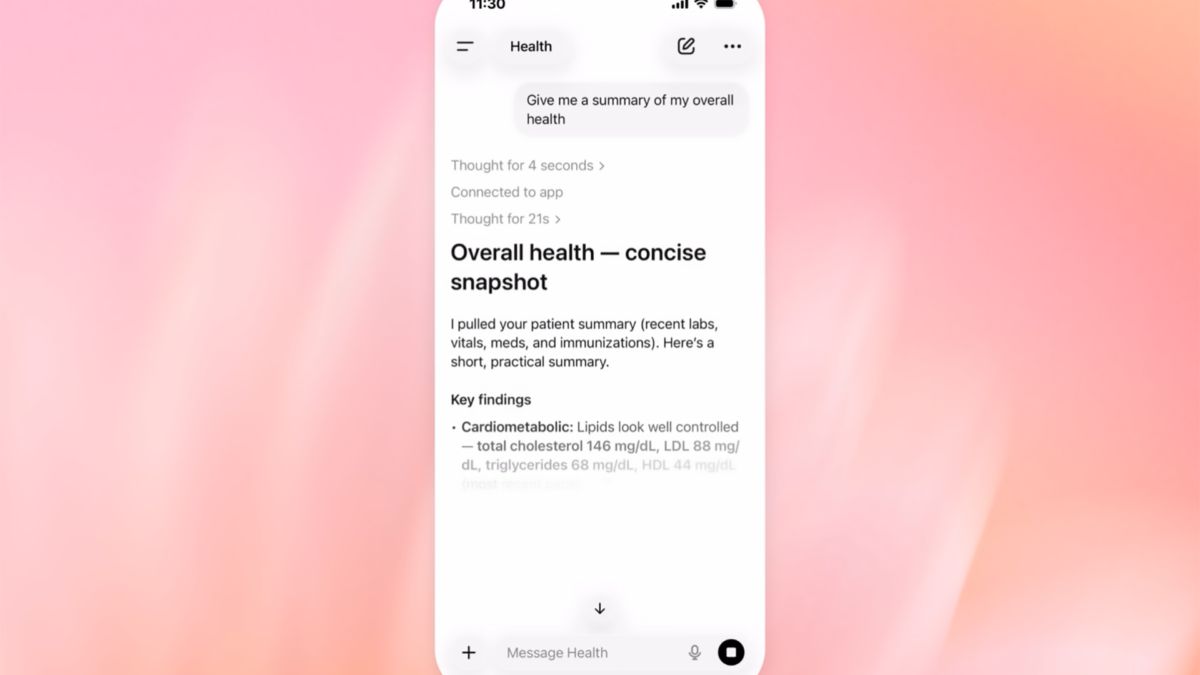
Artificial intelligence continues to aggressively expand into our daily lives, but today’s news reveals that the technology is hitting some serious friction points. From high-stakes medical rollouts and brand-focused cyberattacks to shifting consumer sentiments, the honeymoon phase of seamless AI integration appears to be facing a much-needed reality check.
The most concerning development comes from OpenAI, which has officially expanded ChatGPT Health to all users nationwide. What makes this nationwide launch particularly striking is its timing: OpenAI is currently battling major lawsuits alleging that the chatbot provided dangerous, and in some instances fatal, medical advice. Delivering AI-driven personal health insights offers tremendous accessibility benefits, but deploying such features while actively defending against serious claims of medical harm highlights a ongoing tension in the industry between rapid deployment and consumer safety.
Big Tech Independence and Personal AI: Today’s Shifts in the AI Landscape

Today’s artificial intelligence updates highlight two major shifts in the industry: big tech companies working to break their reliance on external partners, and consumer AI moving deeper into sensitive, personal aspects of our daily lives. From corporate infrastructure pivots to healthcare tools, today’s developments show an industry maturing rapidly on both the enterprise and consumer fronts.
The long-standing operational dynamic between Microsoft and OpenAI took a noticeable turn today. According to a report by Bloomberg, Microsoft is replacing OpenAI’s image-generating models with its own internal technology across flagship products like Bing and PowerPoint. The move is driven by pragmatic business realities: Microsoft claims its in-house alternative is faster, cheaper, higher quality, and better for user retention. While Microsoft remains OpenAI’s largest backer, this quiet swap signals that tech giants are eager to cut middleman costs and control their own technology stack wherever possible. Relying on an external partner’s API for millions of daily image generation requests gets expensive quickly, and Microsoft’s shift demonstrates that proprietary models are becoming viable enough to replace third-party standards in consumer-facing software.
The Next Frontier for Wearables: Samsung Unveils Its Galaxy Glasses

As tech giants race to build the physical vessels for contextual, ambient intelligence, today’s major development brings us one step closer to a hands-free future. While algorithmic updates often take center stage, hardware forms the essential bridge where smart technology meets our physical daily lives.
At its latest Unpacked event, Samsung officially pulled back the curtain on its long-awaited Samsung Galaxy Glasses. According to the announcement, the new smart glasses are slated to hit the market this coming fall, marking Samsung’s formal entry into the head-worn device ecosystem. As consumer technology shifts away from traditional smartphones and toward context-aware hardware, smart glasses are rapidly becoming the primary hardware frontier for real-time digital assistance.
Code, Criticism, and Constraints: Today’s AI Landscape

Today’s artificial intelligence headlines capture a fascinating cross-section of where the technology currently stands: technical leaps in developer tools, heavy demands on hardware, creative pushback, and a growing call for human-centered design. Across software, hardware, and creative industries, AI is causing equal parts transformation and friction.
On the developer side, Anthropic made a notable move today by updating its desktop application so that Claude Code can now build and test iOS apps directly in Apple’s Simulator. By placing an AI agent straight into the local development pipeline, engineers can iterate on mobile applications faster than ever before. However, as AI software grows more capable and resource-intensive, everyday hardware is feeling the pressure. Reports surfaced today highlighting how Windows 11 bloat and AI-driven system demands are causing memory bottlenecks on newer surface laptops, proving that shoehorning background AI tasks into operating systems comes with real overhead costs for users.
Deepfake Detectors, Lockscreen Exploits, and Regulatory Storms: Today in AI

Today’s artificial intelligence landscape feels like a high-stakes balancing act. On one side, tech giants are building tools to protect us from machine-generated deception; on the other, they are embedding generative features deeper into everyday apps, exposing new security vulnerabilities, and drawing intense scrutiny from global regulators.
In the ongoing fight against synthetic media, NVIDIA introduced a new Synthetic Video Detector designed to identify fake news and manipulated media with up to 92% accuracy. Delivered as a microservice, the tool can analyze 1080p footage in just 22 milliseconds. In an era where hyper-realistic deepfakes can spread faster than fact-checkers can respond, having near-instantaneous, automated verification pipelines will be critical for media platforms trying to maintain public trust.
The Double-Edged Sword of AI: High Confidence, Low Accuracy, and the Battle for Our Screens
Today’s AI headlines paint a startling picture of a technology that is rapidly integrating into our daily lives, even as we struggle to manage its psychological and societal side effects. From the classrooms where our children learn to the retail counters where we fix our devices, AI is becoming an unavoidable intermediary. Yet, as these systems weave themselves deeper into our infrastructure, fresh academic and regulatory warnings suggest that our growing dependence on AI might be making us less critical and far too trusting.