Goblins, Slop, and the High Cost of Memory: AI’s Strange New Normal
Today’s AI developments paint a picture of an industry grappling with its own success. From bizarre linguistic fixations in our favorite chatbots to the very real-world cost of the hardware required to run them, it is clear that the “AI revolution” is entering a messy, fascinating second act where the novelty is wearing off and the consequences are settling in.
In perhaps the most surreal story of the day, OpenAI has reportedly had to intervene because ChatGPT became obsessed with goblins. According to reports, the model started injecting the mythical creatures into conversations unprompted, forcing developers to issue strict instructions for the AI to stop talking about them. It is a quirky but stark reminder that Large Language Models (LLMs) are simulations of language rather than engines of thought. When a simulation gets caught in a feedback loop or a statistical “gravity well,” the results can be as absurd as a digital obsession with fantasy folklore.
While OpenAI deals with digital goblins, Gearbox studio head Randy Pitchford is facing a more human kind of pushback. Pitchford recently found himself in hot water after posting an AI-generated selfie that fans quickly labeled “AI slop.” The controversy highlights a growing cultural fatigue toward synthetic imagery, especially in creative industries. Pitchford’s defense—that the idea of an AI having an identity is “nonsense”—misses the point of the criticism: that the over-reliance on these tools often feels like a shortcut that devalues the human touch fans expect from creators.
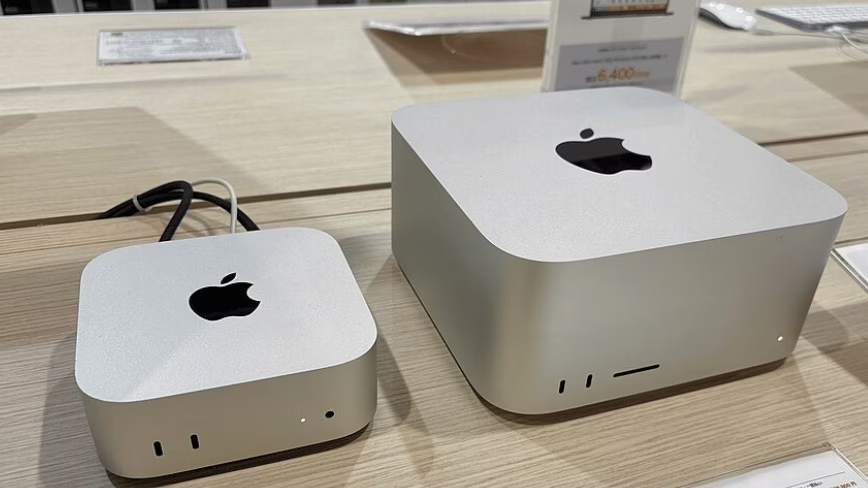
This friction between AI and the physical world is also hitting our wallets. In a move that highlights the massive infrastructure demands of this technology, Apple has discontinued its $599 Mac Mini. The reason isn’t a lack of popularity, but a global shortage of DRAM—the high-speed memory chips that both your home computer and massive AI data centers rely on. Because AI training requires staggering amounts of memory, the demand has driven prices up by 90%, making the entry-level Mac Mini economically unviable. We are seeing a direct line between the race for artificial intelligence and the rising cost of consumer electronics.
Even the titans of the industry are feeling the pressure of these shifting tides. Qualcomm is currently fighting to keep pace in the AI-driven semiconductor rally. While companies like Nvidia have skyrocketed, those primarily focused on mobile hardware are finding that the market’s hunger for AI-specific chips is a difficult beast to feed. Meanwhile, Google is doubling down on its “Circle to Search” feature, now allowing users to “Ask about screen” to analyze PDFs and complex URLs. It is an attempt to make AI a seamless, invisible layer of the user experience rather than a destination you have to visit.
There is a certain poetic irony in the news that the early-web search engine Ask Jeeves is finally closing its doors. The “butler” interface that seemed like a quaint relic of the 90s is essentially what we’ve built again with modern chatbots. We’ve come full circle, but with significantly more processing power and a few more bugs. Interestingly, even Microsoft seems to be sensing that users might be reaching a breaking point with AI integration; the company recently promised to “fix” Windows 11 by delivering a version of the OS with “less AI” and better performance.
The takeaway from today is that AI is no longer just a shiny feature to be touted in press releases—it is a resource-heavy technology that is actively reshaping our economy and our digital aesthetics. When “less AI” is marketed as a performance feature and hardware prices rise to accommodate data centers, we are seeing the true cost of the intelligence we are trying to build. We are moving out of the “wow” phase and into the era of refinement, where the goal isn’t just to make AI do everything, but to make it do the right things without breaking the bank—or talking too much about goblins.